Featured

What Can a Writer Do?

“My mission in life is not merely to survive, but to thrive; and to do so with some passion, some compassion, some humor, and some style.” – Maya Angelou

For the longest time, I figured that my passion in writing meant that I would have a minuscule chance at obtaining a real job; I soon realized that my passion writing meant that I would have too many chances at getting a real job.

My name is Taheera Washington, and I’m currently a sophomore at St. Edward’s with a major in Writing and Rhetoric with a concentration in Creative Writing and a minor in Digital Marketing. From my school’s newspaper – Hilltop Views – to poetry publications like New Literati and Arete, I do just about as much writing as you would think that I do, but many writers are often faced with the question on what do we want to do – better yet, what can we do? The answer is simple – anything that requires a computer and someone else out there to read it.

In my time here at St. Edward’s, I have found that my passion for writing includes its flexibility of genres. From content development to short stories, all means of writing must fulfill the goal of informing someone out there to new information and content. Writing is an outlet for creatives while simultaneously providing people to new discoveries and epiphanies on their subject of choice.

That all potentialy sounds pompous, but trust me when I say that writing is truly my life.

In high school, I thought that I could only pursue one form of writing, so I took turns in developing my craft. For a while, poetry consumed my life to say the least. I joined the Texas Poetry Society in tenth grade and even won awards for a couple of other poems and short stories, but it wasn’t enough. I had to do more with my time; at least, that’s what my mother told me.

Becoming copy editor for my school’s press – the Panther Prints – during my senior year was the highlight of my career in my eyes. It’s what I worked for by enduring the trials and tribulations of Yearbook in ninth grade, and it paid off by providing scholarships and expanding my knowledge as a writer through my craft. Understanding AP style and normal grammar rules made me, for lack of a better term, more powerful as a writer. It’s like I unlocked a new skill in a video game, and now I could use it to its full potential.

Except I didn’t and moved onto something entirely different. I was keen on becoming a writer of pride, wanting to become more like, Jericho Brown, Toni Morrison, or James Baldwin in terms of excellence for my community. In starting my own e-book series on Issuu.com a year ago, I found that establishing myself as a freelance writer was to be difficult. It required a level of marketing, social prominence, and confidence to build up a reputation and following deemed worthy of such pride. However, it aided in developing my graphic design skills since there’s no one else other than me that sees my work before it goes online.

Still, that wasn’t enough for me. It should’ve been, but it wasn’t.

As a writer, it is essential that you push yourself to your limits. If you think you know everything, then you’re either egotistical or you’re shortening yourself of your capabilities; for a good writer to be considered ‘good’, they must be well rounded. Interning at the Texas Book Festival as a Development and Finance Intern pushed me to my limits. I was thrown completely out of my comfort zone with the mentioning of finance; this was before I decided fully to become a Digital Marketing minor. Creating Excel sheets, contacting publicists and authors, organizing files, answering business calls, taking count of books… it was all things I didn’t consider to be in my line of work. How can a writer be trusted to do anything related to math? I didn’t understand then, but the difficulties faced there were a learning curve. If I limit myself to what I can and cannot do, then how will I be able to grow?

So, now we’re here. What can a writer do? A better question to ask is what can’t one do, but to answer our looming question, a writer can do whatever they allow themselves to be capable to do. In having the will to succeed, they must be impassioned by their passion to write to continue learning.
Finding What’s Write for You

Did you like the pun in the title?

Amidst this past month, I’ve been trying to discover what works best for me as a writer in terms of understanding how brand awareness would work for me. Knowing that social media and writing is often a push and pull dynamic since people don’t want to “read” when they look at a post, it’s difficult to narrow down the tools needed to use. However, only one form of social media marketing seems to efficient in building the credibility and awareness to gain a following, and that’s with microblogging.

Microblogging is a concept utilized best with Twitter; it’s just the simple post, engage, and repeat, but it’s effective, especially with the current generation. In terms of who my audience is, it would most likely concern a majority of those who are closer to me in age or perhaps a generation before; most of my following and followers reflect this notion. Either way, Twitter is often known as a platform where you have to understand the way to effectively communicate to your ‘circle’ on the application, or you will lose your credibility and be shunned.

In the end, microblogging is the most effective for brand awareness due to it forcing you to have the confidence to engage with your audience actively in order to not lose relevance, as well as being confident in your professional brand image. For the writing community, there isn’t one set image. You can be whoever you want to be as long as it is reflective of you and the type of brand you’re promoting; it’s essential to be creative with it as well. From the types of writer microbloggers that I see, often times their professional brand is mixed with their personal images in order to promote authenticity and a certain lightheartedness. For writers, you don’t necessarily get to see their personalities whether it’s with fiction, poetry, or journalism; you get to see a reflection of their style or voice in an article or piece of fiction – not the writer themselves, so this is an act of connecting with your audience that I find helpful.

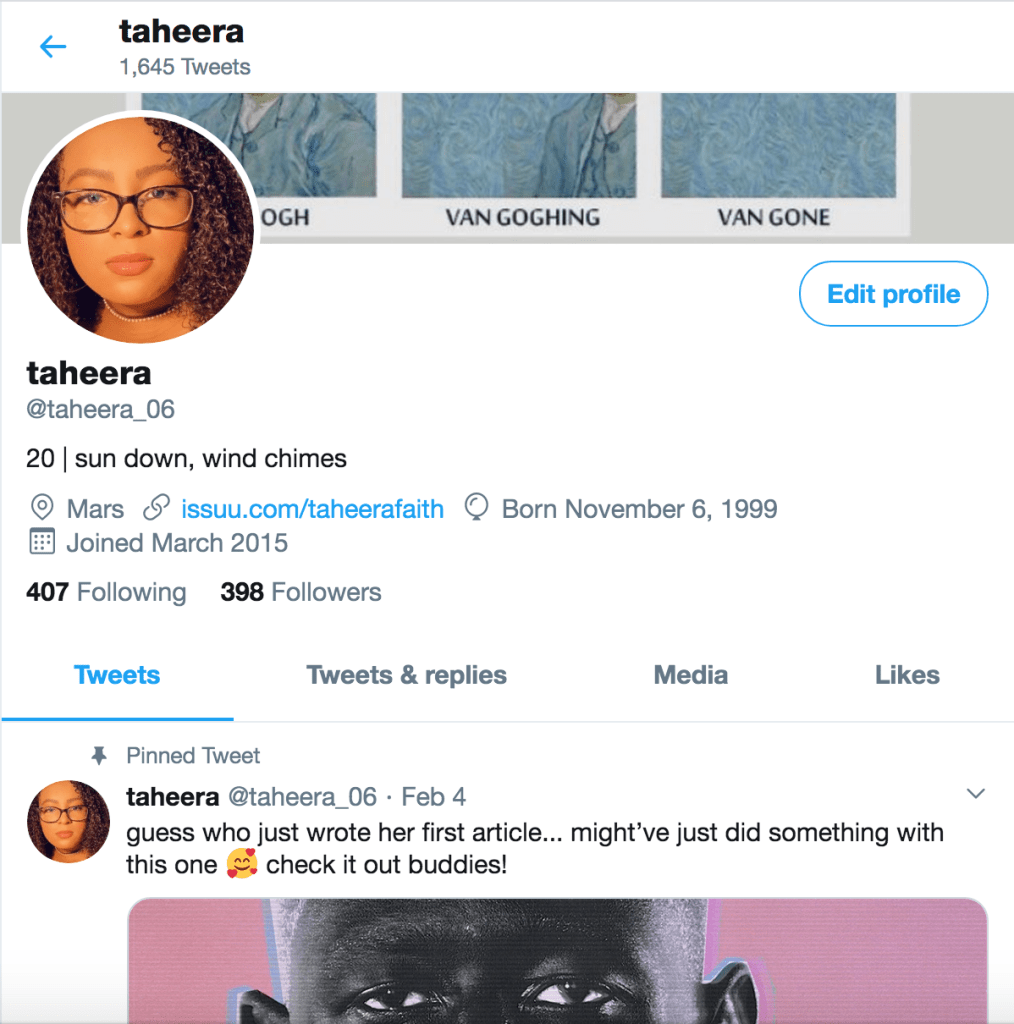
Here, you can see the type of music that I listen to with the lyrics to Solange’s “Binz” in the profile description next to my age, and my followers have access to my online book series through Issuu.com. This mixture of professionalism and personal branding that works best in building a steady engagement; through this, posting articles or retweeting other articles is met with exceptional responses that isn’t like interruptive advertising in the way unwanted posts could disrupt someone’s feed. This is something that’s widely known of my profile, and through this exercise, I discovered the way the amplify the power of microblogging to almost its fullest potential.

Through this blogging exercise, I’ve found myself with a better understanding and insight to the types of social media profiles I surround myself around and how that reflects me. Even with something as little as following blogs with similar professional brands to yours makes a difference than the standard people that you know. It’s never to early to begin building your professional brand despite whether you have a job or in school where it wouldn’t affect you. Social media is a reflection of the type of person that we are trying to be, so it’s probably the write time to get into building your brand.

Work Timeline

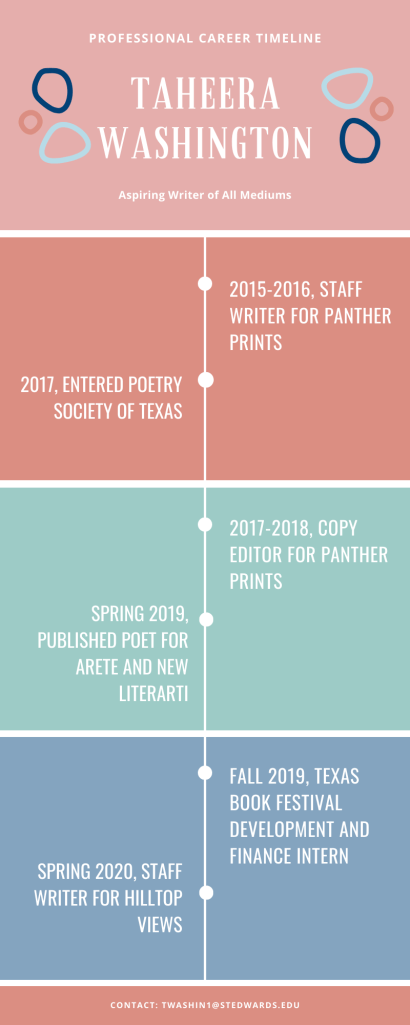
While it’s been discussed briefly, the most important thing to anyone is their experience and what makes them believable. Although I’m only a sophomore in college, there’s been quite a few things that have built up my work experience. So, attached below is a linear timeline of my official writer’s timeline.

The inclusion of my high school experience comes with the fact that it was not only my first exposure to the grammatical sides of writing that have built up skills necessary to where I am currently, but my work on that publication has received the Silver and Gold Award by the Columbia Scholastic Press Association – the highest award for a publication. Whoever tells you that high school doesn’t matter anymore is wrong because I’ll continue to boast about that. That was hard work.

For now, I can say that I’ve dabbled into professional, journalistic, and creative mediums of writing, making my writing tool belt fuller and fuller. It’s important to put yourself out there, but it’s also important to dabble in a little bit of everything just to get a good sense of all there is to offer.

Writing Blog Analysis: What Are They Doing?

Every blogger is essentially writer, so finding blogs referring to writing communities is kind of ironic.

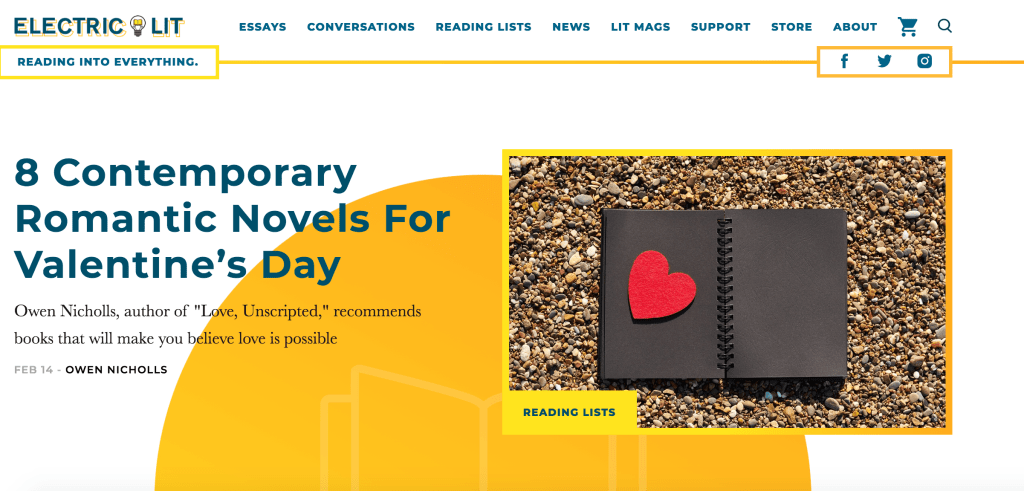
Here’s where Electric Literature comes in. Electric Literature, first established in 2009, is every writing connoisseur’s dream. With the mission statement being ” to amplify the power of storytelling with digital innovation, and to ensure that literature remains a vibrant presence in popular culture by supporting writers, embracing new technologies, and building community to broaden the audience for literature,” they provide outlets for upcoming authors to submit their work, staff writers to write essays or reviews, and access to their literature magazine. Here, Electric Literature provides plenty of new content for readers to take in at their leisure, even at a scheduled leisure if you choose to subscribe to their news letter. They provide you with all of the electric feels.

With a Twitter, Facebook, and Instagram following promoted seamlessly through their website’s layout, this blog is not intruding their readers’ space in a form of permission marketing. However, there are quite a few pop-ups, prompting readers to subscribe – which is an obvious form of interruptive marketing. I believe that having as healthy of a balance like Electric Literature doesn’t make the marketing implemented feel like they’re forcing content into your face too much. It’s not overdone, yet it’s not underdone.

The layout of their website is aesthetically pleasing and different than most blogs. While most blogs tend to avoid color, Electric Literature plays into their name by implementing a touch of golden yellow – like a lightning bolt – within all of their content.

Their post layouts is admirable and pretty electric; I’ll stop with the electric puns now. Firstly, the complimenting colors of the bright yellow with the navy blue works into the whole color theory idea, but also it creates a good sense of juxtaposition that works in not overbearing their readers. They have a slider at the top with the post’s title in the box, and as you scroll, it fills into a golden gradient to signal how far you are into their article. They even provide you with a little synopsis of who or what they’re talking about and even their twitter handles; this part of the blog follows you as you scroll. Design wise, Electric Literature understands how to attract their readers. Get it?

On the down side, there’s a bit of convolution business when it comes to their tool bar layout. It’s not in alphabetical order was the first thing that I noticed. What I also noticed is that there’s a store button but also a shopping cart button, both of which referring to their online shop. I feel as though one is unnecessary, and they should probably clean that up, as well as their bottom tool bar that just feels crowded. However, this is me nitpicking their blog. I personally think they have a nice balance of content and layout going on.

In all, Electric Literature shocks you with all of their electric goodness. They clearly understand who their audience is, but they allow for there to be room for new and experimenting viewers to be able to join in on the conversation.

Create your own website, free on WordPress.com.Create your own website.
Start free